The grand eclectus female is mostly bright red with a darker hue on the back and wings. The mantle and underwing coverts darken to a more purple in colour, and the wing is edged with a mauve-blue. The tail is edged with yellowish-orange above, and is more orange tipped with yellow underneath.
General Description
| Name: | Eclectus Parrot |  |
|
|---|---|---|---|
| Latin Name: | Eclectus roratus | ||
| Life Span: | 50 years | ||
| Length: | 35 cm | ||
| Weight: | 250 – 330 g | ||
| Wingspan: | |||
| Sexual Maturity: | Male three to four years, female two and half to three years. | ||
| Breeding Season: | |||
| Clutch: | Two eggs, each egg measuring 40.2 x 31.0 mm in size. | ||
| Nesting: | In its natural habitat, the Eclectus nests within hollows in large, emergent rainforest trees. Suitable hollows are at a premium and the hen will vigorously defend her chosen nesting site from other females (perhaps even fighting to the death), remaining resident at ‘her tree’ for up to 11 months of the year. | ||
| Natural Diet: | The diet of the eclectus in the wild consists of mainly fruits, wild figs, unripe nuts, flower and leaf buds, and some seeds. In captivity, they eat most fruits including mangos, figs, guavas, bananas, melons, stone fruits, grapes, citrus fruits, pears, apples, pomegranate, and papaya (pawpaw). The eclectus has an unusually long digestive tract, so tolerates a high-fiber diet. | ||
| Gender Difference: | DNA testing is required | ||
Sub-Species
| SUB-SPECIES PROPERTIES |
|
| LATIN NAME | DIFFERENCES |
|---|---|
| Eclectus roratus roratus | The subspecies begins intergrating with race vosmaeri on Seram. |
| Eclectus roratus vosmaeri | Larger in size than the nominate subspecies with more yellow in the plumage, the male has more yellow-toned plumage on the head and neck. The tail is bluer and has a small pale lemon yellow border. The female is a brighter red on the head, back and wings. Her undertail coverts are yellow and there is at least an inch of bright pure yellow tail tip |
| Eclectus roratus cornelia | Also larger than the nominate, the male is a paler shade of green overall and has a bluer tail. The female has an all red plumage, except for the primaries which are a dark royal blue. |
| Eclectus roratus riedeli | It is smaller than the nominate race. The male has a more bluish tinge to its green cheeks and neck, and its tail is edged with a broad band of yellow. The female has all red plumage, except for royal blue primaries and a broad band of yellow to edge the tail. |
| Eclectus roratus polychloros | Larger than the nominate race. The green plumage of the male only has a slight yellow tinge and the tail is tipped with a half inch yellow band. The central tail feathers are green and lateral ones blue and green. |
| Eclectus roratus macgillivrayi | It resembles polychloros but is larger overall |
| Eclectus roratus solomonensis | Resembles polychloros but is smaller overall with smaller bills and paler orange in the upper mandible of the male. The green of the male has a more yellow tint, quite similar to the green of the vosmaeri. |
Habitat
Is a parrot native to the Solomon Islands, Sumba, New Guinea and nearby islands, northeastern Australia and the Maluku Islands (Moluccas).
Eclectus roratus roratus is found on Buru, Seram, Ambon, Saparua and Haruku in the southern Maluku Islands.
Eclectus roratus vosmaeri is found on islands in the North Maluku province
Eclectus roratus cornelia is restricted to Sumba island in the Lesser Sunda Islands.
Eclectus roratus riedeli is found on the Tanimbar Islands.
Eclectus roratus polychloros is widely distributed from Kai Islands and western islands of the West Papua province in the west, across the island of New Guinea to the Trobriands, D’Entrecasteaux Islands,
Eclectus roratus macgillivrayi is found on the tip of Cape York Peninsula.
Eclectus roratus solomonensis is found on the Solomon Islands.
Status
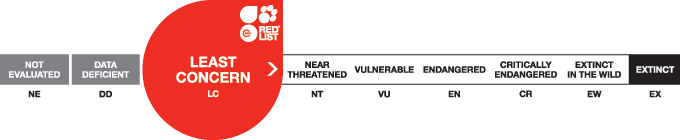
Classified as Least Concern (LC) on the IUCN Red List and is listed on Appendix II of CITES (May 2012).