General Description
| Name: | African-Grey Parrot |  |
|
|---|---|---|---|
| Latin Name: | Psittacus erithacus | ||
| Life Span: | 50 – 60 years | ||
| Length: | 25 – 36 cm | ||
| Weight: | 407 g | ||
| Wingspan: | 46 – 52 cm | ||
| Sexual Maturity: | Male three to four years, female two and half to three years. | ||
| Breeding Season: | Coincides with the dry season | ||
| Clutch: | Three to five eggs, each egg measuring 34.0 X 26.9 mm in size. | ||
| Nesting: | Grey parrots are monogamous breeders who nest in tree cavities. Each mated pair of parrots needs their own tree for their nest. | ||
| Natural Diet: | They are mostly frugivorous as most of their diet consists of fruit, nuts, and seeds. The species prefers oil palm fruit and they eat flowers and tree bark, as well as insects and snails. In the wild, the grey parrot is partly a ground feeder. | ||
| Gender Difference: | Individuals of this subspecies have distinct red tails and solid black beaks. These birds have bare white face patches and sometimes bright, usually pale, silvery yellow eyes. Many of the grey contour feathers are edged with white. This gives them a smooth, lacy appearance. They may be somewhat sexually dimorphic. | ||
Habitat
The grey parrot is native to equatorial Africa, including Angola, Cameroon, the Congo, Gabon, Ivory Coast, Ghana, Kenya, and Uganda. The species is found inside a range from Kenya to the eastern part of the Ivory Coast. Current estimates for the global population are uncertain and range from 630,000 to 13 million birds. Populations are decreasing worldwide. The species seems to favor dense forests, but can also be found at forest edges and in more open vegetation types, such as gallery and savanna forests

Gender Identification
DNA testing is necessary. Female is a bit shy, the male a bit bolder, differs for every parrot.
Status
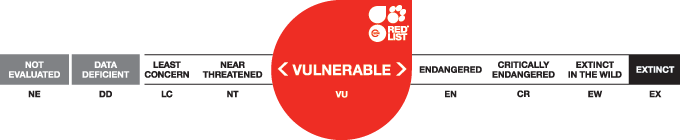
Classified as Vulnerable (VU) on the IUCN Red List and is listed on Appendix II of CITES.